

Hey there! As a supplier of single jet water meters, I'm super excited to break down how these nifty devices work. So, let's dive right in!
The Basics of a Single Jet Water Meter
First off, what exactly is a single jet water meter? Well, it's a type of water meter that measures the volume of water flowing through a pipe. It's widely used in both residential and commercial settings because it's relatively simple, reliable, and cost - effective.
The main components of a single jet water meter include an inlet, an outlet, a measuring chamber, a turbine or impeller, and a register. The water enters the meter through the inlet and then flows into the measuring chamber. This is where the magic happens!
How the Water Flow Affects the Turbine
Once the water is in the measuring chamber, it hits a small turbine or impeller. The force of the water causes the turbine to spin. Think of it like a little windmill, but instead of wind, it's powered by water. The speed at which the turbine spins is directly proportional to the flow rate of the water. That means if more water is flowing through the pipe, the turbine will spin faster, and if less water is flowing, it'll spin slower.
The design of the single jet water meter is such that the water jet is directed precisely at the turbine. This ensures an efficient transfer of energy from the water to the turbine, allowing for accurate measurement of the water flow.
Measuring the Spinning Turbine
Now, how do we measure the spinning of the turbine? Well, there are a few different ways, but most single jet water meters use a mechanical or electronic system.
In a mechanical system, the spinning turbine is connected to a series of gears. As the turbine spins, it turns these gears, which in turn move the dials on the register. The dials are marked with numbers, and by reading these numbers, you can determine how much water has passed through the meter.
On the other hand, electronic single jet water meters use sensors to detect the rotation of the turbine. These sensors send signals to an electronic circuit, which then calculates the volume of water based on the number of rotations. Electronic meters are often more accurate and can provide additional features like remote reading.
The Role of the Register
The register is the part of the water meter that displays the water consumption. It's usually located on the top of the meter and is visible through a clear cover. The register shows the total volume of water that has passed through the meter since it was installed.
In some cases, the register may also have a digital display, which can provide more detailed information about the water usage, such as the current flow rate or the amount of water used during a specific period.
Types of Single Jet Water Meters
There are different types of single jet water meters available in the market. For example, we have the Plastic Single Jet Water Meter. These are made of high - quality plastic, which makes them lightweight, corrosion - resistant, and affordable. They're a great choice for residential applications where cost is a concern.
Then, there's the Russian Market Single Jet Water Meter. These meters are specifically designed to meet the requirements of the Russian market, taking into account factors like water quality, temperature, and pressure.
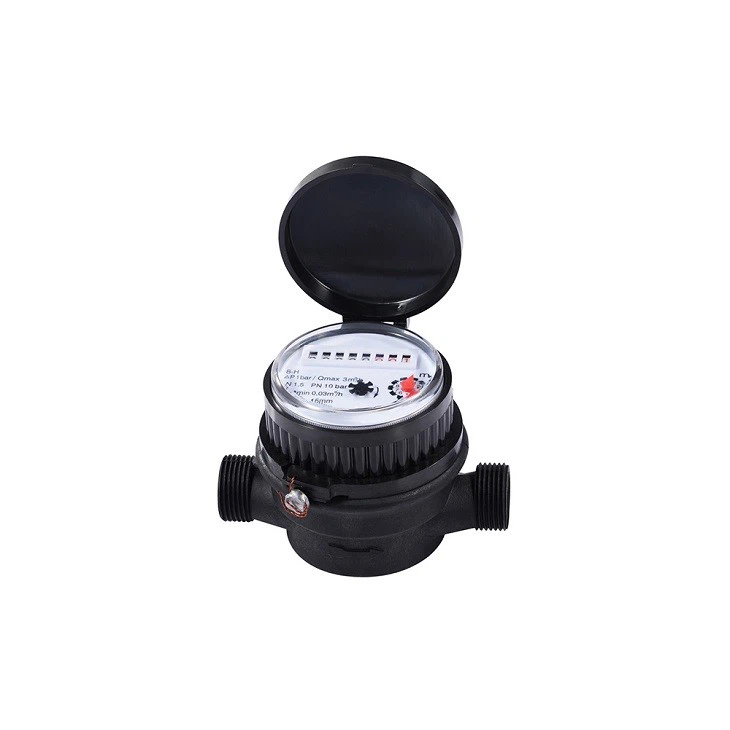

And let's not forget the Wet Brass Single Jet Water Meter. Brass is a durable and long - lasting material, making these meters suitable for both residential and commercial applications where reliability is key.
Advantages of Single Jet Water Meters
One of the biggest advantages of single jet water meters is their accuracy. They can accurately measure even small flows of water, which is important for billing purposes. They're also relatively easy to install and maintain. Most single jet water meters can be installed by a plumber in a matter of hours, and regular maintenance usually just involves checking for leaks and ensuring the meter is clean.
Another advantage is their cost - effectiveness. Compared to some other types of water meters, single jet water meters are relatively inexpensive to purchase and operate. This makes them a popular choice for both water utilities and consumers.
Limitations of Single Jet Water Meters
Of course, no water meter is perfect, and single jet water meters do have some limitations. One limitation is that they can be affected by the quality of the water. If the water contains a lot of sediment or debris, it can clog the meter or damage the turbine, leading to inaccurate readings.
Another limitation is that they may not be suitable for very high - flow applications. In situations where there is a large volume of water flowing through the pipe at a high speed, a single jet water meter may not be able to accurately measure the flow.
Applications of Single Jet Water Meters
Single jet water meters are used in a wide range of applications. In residential settings, they're used to measure the water consumption of individual households. This information is then used by water utilities to bill customers for their water usage.
In commercial settings, single jet water meters are used in small businesses, restaurants, and offices. They help these establishments keep track of their water usage and manage their water costs.
Conclusion
So, there you have it! That's how a single jet water meter works. It's a simple yet effective device that plays a crucial role in measuring water consumption. Whether you're a homeowner looking to keep track of your water bill or a business owner trying to manage your water costs, a single jet water meter is a great choice.
If you're interested in purchasing single jet water meters for your home or business, we'd love to hear from you. We offer a wide range of high - quality single jet water meters at competitive prices. Just reach out to us, and we'll be happy to discuss your specific needs and help you find the right meter for you.
References
- "Water Meter Handbook" by the American Water Works Association
- "Principles of Water Metering" by various industry experts